
Custom Cabinets
From Ordinary to Extraordinary: Choosing the Perfect Kitchen Cabinets for Your Renovation
By
Amber Niewald

Galley kitchens are common in Washington DC, and not by accident. The rowhouse footprint that shapes Capitol Hill, Georgetown, and Mount Pleasant produces long, narrow rooms almost by default, and the Cape Cods and bungalows further out in Takoma Park and Silver Spring were often built to similar proportions. In these homes a galley layout is not a compromise. It is what the architecture produced.
What makes a galley kitchen feel tight is rarely the width of the room. It is a layout planned around a household that cooked and lived differently: storage in the wrong places, one overhead fixture doing all the work, and appliances sized for a kitchen that was never this shape. Addressed properly, the linear layout is one of the most efficient arrangements there is, and a well-planned kitchen remodel usually starts by working with that shape rather than fighting it.
A galley kitchen puts everything within a few steps. That is its real advantage, and the layout should be planned to take it.
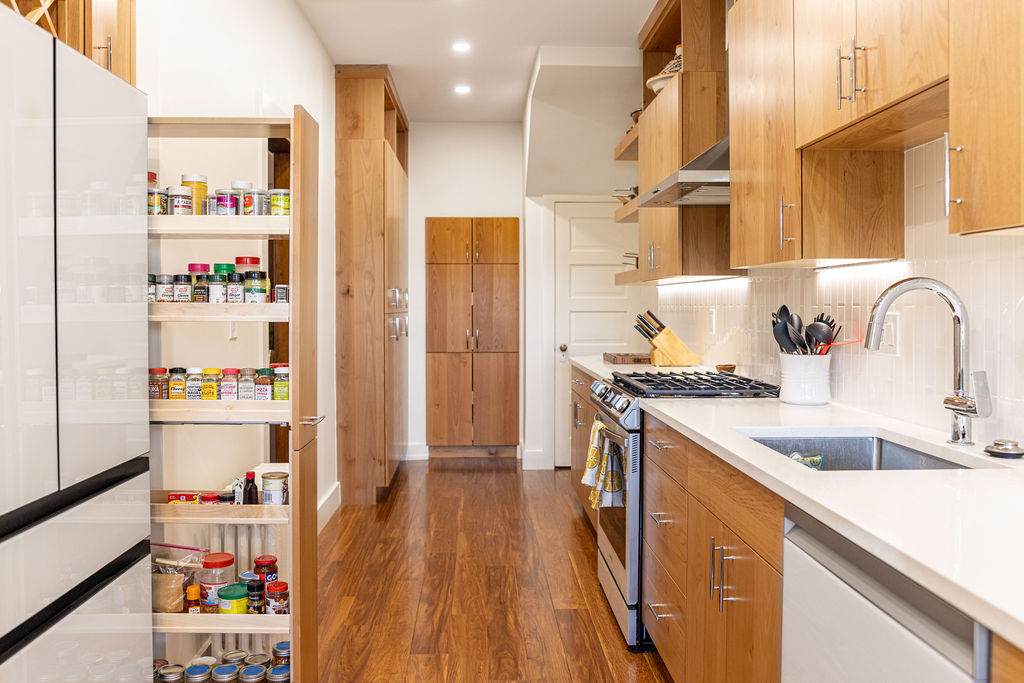
Arrange appliances and cabinetry along both walls so the sink, cooktop, and refrigerator sit in a short, uninterrupted run. Keep the walkway between them clear — the most common mistake in a narrow kitchen is placing something that opens into the path where two people need to pass. Dishwasher doors, oven doors, and the swing direction of the refrigerator matter far more here than they do in an open plan, and they are decided at the drawing stage, not on site.
Aisle width is the other decision that sets everything else. A galley needs enough room for a person to stand at the counter while someone else passes behind them, and more if two people cook at once. Going too narrow makes the room unusable at exactly the moments it is busiest; going too wide wastes reach on both sides. The right number depends on how many people are in the kitchen at the same time, which is why it is worth thinking through how your household actually moves through the space. Our piece on designing a kitchen layout around daily rituals works through that in more detail.
Galley kitchens are often interior rooms with a single window at one end, which means natural light drops off quickly and the far end of the run can sit in shadow all day. Lighting is not a finishing touch here. It is what makes the room usable.
Under-cabinet lighting is the highest-value addition in almost every galley kitchen. In a narrow room you are standing directly between the overhead fixture and the counter, so you cast a shadow across your own work surface. Under-cabinet fixtures put light where you are actually chopping and prepping and remove that shadow entirely.
Above that, layer in ambient light along the length of the run rather than a single central fixture, and add pendants over the primary work zone if the ceiling height allows. Dimmers matter more in a small room than a large one, because the difference between cooking light and evening light is the difference between the room feeling like a work space and feeling like part of the home. Our guide to kitchen design lighting for DC homes covers how those layers work together.
In a galley kitchen, floor space is finite and wall space is the resource you have. Using it fully is what determines whether the room feels organised or crowded.
Take cabinetry to the ceiling rather than stopping short and leaving a dust ledge. The top run holds what you use twice a year and keeps the working shelves clear. Below the counter, drawers outperform doors in a narrow room by a wide margin — you pull the contents out to you instead of crouching into a cabinet in a space where there is no room to crouch. Pull-out pantry units, tray dividers, and deep drawers for pots do more for a galley kitchen than any single design decision besides the layout itself.
Custom cabinetry earns its cost here more than in a larger kitchen, because the awkward dimensions of a narrow room are exactly what stock sizes handle badly. A run built to the actual measurements of your walls recovers inches that a catalogue cabinet leaves as filler panels. Our approach to custom cabinetry is built around that fit, and there are further ideas in our post on kitchen remodel space-saving ideas.

Should You Open Up a Galley Kitchen?
Standard appliance sizes assume a standard kitchen. A galley is not one, and forcing full-depth appliances into a narrow run costs you circulation space you cannot spare.
Counter-depth and slimline refrigerators sit flush with the cabinetry instead of protruding into the walkway. Slide-in ranges avoid the bulk of a freestanding unit with a rear control panel. Built-in or drawer microwaves clear the countertop entirely. Narrower dishwashers are worth considering in a kitchen serving one or two people, where the capacity of a full-width unit goes unused.
None of this means accepting less. It means selecting appliances against the dimensions you have, which is a decision best made while the layout is still on paper — appliance specifications drive cabinet dimensions, not the other way around.
Surfaces determine how large a narrow room feels. Materials that bounce light lengthen the space visually; materials that absorb it close the room in.
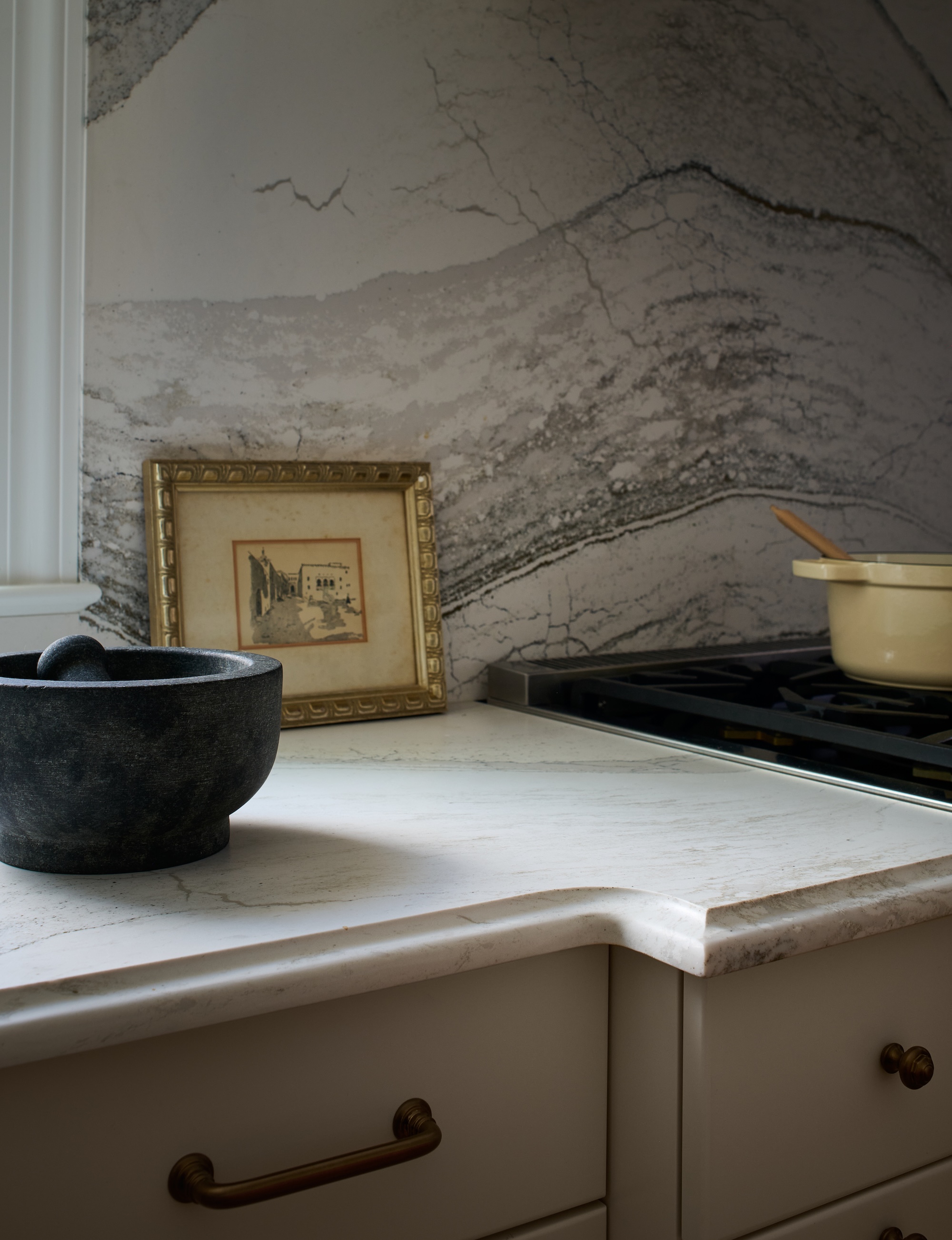
That does not require a high-gloss kitchen. A honed stone counter, a light backsplash, and cabinetry in a warm, mid-tone wood will move light through a galley just as effectively as glossier finishes, and they age better. The choice between them is largely about how you want the room to feel. Our post on selecting warm, minimalist cabinetry goes into how material and tone shape that, and our guide to choosing colours for a kitchen remodel covers the same question across the whole room.
The rule that holds regardless of finish: keep the number of materials low. Visual busyness reads as clutter faster in a narrow room than anywhere else in the house.
This is the question most DC homeowners ask first, and the answer is genuinely case by case.
In some rowhouses, removing a wall between the kitchen and an adjacent room transforms how the whole floor works. In others, the wall is structural, or it carries mechanical runs, or opening it up costs you the wall space the kitchen depends on for storage — and you end up with a more open room that functions worse. In historic districts there are further considerations around what can be altered and what approvals are required.
It is worth being clear-eyed that a galley kitchen kept as a galley is not a lesser outcome. Many of the most efficient kitchens are narrow ones. What matters is that the decision is made with the structure, the mechanicals, and the way you use the floor all on the table at once. Our post on kitchen flow design for historic rowhomes covers how that question gets worked through, and historic home remodeling covers the approvals side.
One related note: homeowners often ask about adding an island to a galley kitchen. In most true galley footprints the aisle width will not support one, and a peninsula or a moveable prep cart serves the same purpose without blocking the run. Our guide to kitchen island sizes sets out the clearances that decision depends on.
In a narrow kitchen, layout decisions and construction realities are the same conversation. Whether a wall can move, where the plumbing can run, how deep the cabinets can be before the walkway suffers — none of that can be settled by a drawing alone, and none of it should be discovered during demolition.
Because your designer and builder are part of the same team working from the same plan, those constraints are known before anything is ordered. That matters in every project and it matters more in a galley kitchen, where a few inches in either direction changes how the room works.
Calm by design, our process provides clarity and structure throughout your renovation. You make the decisions; we guide the experience.
We start with a 30-minute call to understand your goals and confirm we're a fit. If it feels right, we schedule an on-site visit to walk your space, take measurements, and explore what's possible within your budget. If you're still working out what that budget looks like, our guide to kitchen remodel costs in Washington DC sets out the ranges honestly.
Your designer guides you through two phases, schematic layout and detailed finish selections, with your budget and how your family lives at the forefront of every decision. All elements are considered together, not assembled separately.
Your dedicated project manager becomes your single point of contact. They coordinate DC permitting, manage material deliveries, and oversee construction from demolition through finishing details.
We walk the space together to confirm everything functions as intended. Every renovation comes with a five-year workmanship warranty along with Crystal Cabinet Works' limited lifetime warranty.
Learn more about our complete process.
You can see how these decisions play out in finished kitchens across DC in our portfolio, and read what homeowners have said about working with us in our reviews.
Ready to see what your galley kitchen could become? Schedule a 30-minute consultation to get started.




.avif)


